history
La Pavoni Lever Machines: Ideale to the Europiccola
By Home Espresso Bar Editorial Team · November 1, 2026

The story of La Pavoni’s lever espresso machines traces patents, workshops, and design collaborations from a modest Milanese workshop in 1905 to the 1974 Professional that La Pavoni says is on display at New York’s Museum of Modern Art. By the end of this article you will understand who founded the company, how the Ideale emerged from an earlier Bezzera patent, why the tiny “Europiccola” bears its name, which designers shaped its form, when the larger Professional model entered the market, and what evidence supports the museum claim. The narrative also separates the documented patent trail from disputed dates, giving a clear picture of the machine’s evolution and lasting design appeal.
Key takeaways
- Desiderio Pavoni opened a Milan workshop in 1905 and launched the Ideale, a machine derived from Luigi Bezzera’s early espresso-machine patent1.
- The Ideale was a vertical-boiler machine built to generate up to about 1.5 bar of pressure and required roughly a minute per cup, with serial production beginning in 19057.
- “Europiccola” name suits it because piccola means small, describing a miniature bar machine introduced in 19613.
- The design of the Europiccola traces back to Piero Diamanti’s 1959 ornamental design patent for the D.P. Caferina, which La Pavoni adopted after the patent expired5.
- The Professional lever machine appeared in 1974 according to the centenary monograph, featuring a pressure gauge and making twice the coffee3.
- La Pavoni states that a 1974 Professional is on display at MoMA, and Wikipedia notes that the machine was included in MoMA’s 2005 Architecture and Design inaugural installation26.
Origins and the early patent trail
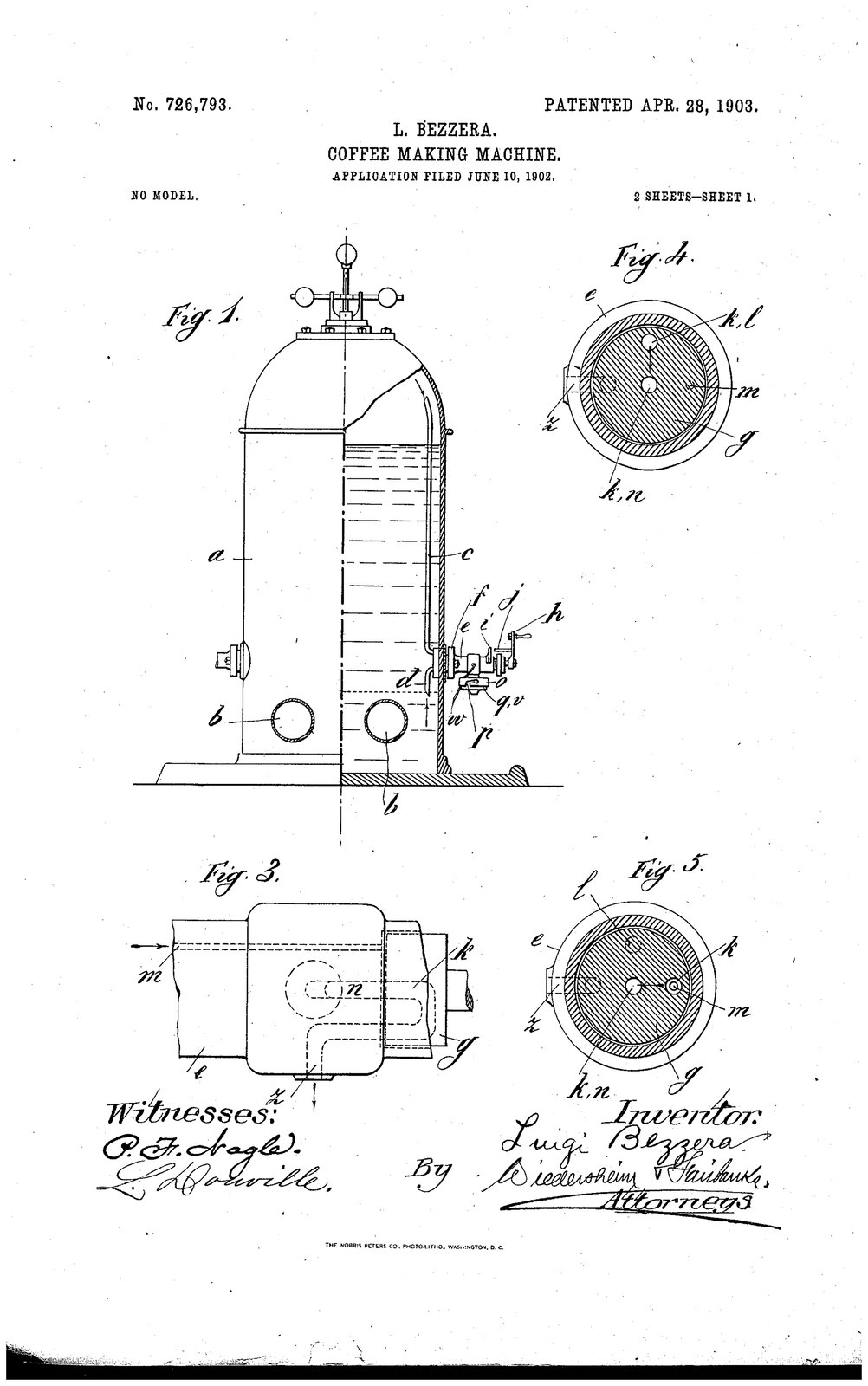
The commercial roots of La Pavoni lie in a small workshop on Via Parini in Milan, opened by Desiderio Pavoni in 19054. Pavoni’s first invention was a filter holder, which quickly led to the company’s inaugural espresso machine, the Ideale1.
The technical foundation of the Ideale rests on Luigi Bezzera’s patent for a coffee-making device filed on 19 November 1901 (Wikipedia lists 19 December 1901)6. The centenary monograph records that an Italian gazette on 13 January 1904 announced the transfer of Bezzera’s patent, originally dated 5 June 1902, to Desiderio Pavoni via a private deed signed on 1 September 19023. Pavoni subsequently purchased Bezzera’s company in 1904, initially retaining the Bezzera name; the 1906 Milan trade fair still displayed the brand as “Bezzera L. Caffè Espresso”3.
These documents establish a clear legal lineage: Bezzera’s early patent, its transfer to Pavoni, and the subsequent re-branding that set the stage for the Ideale’s production.


The Ideale
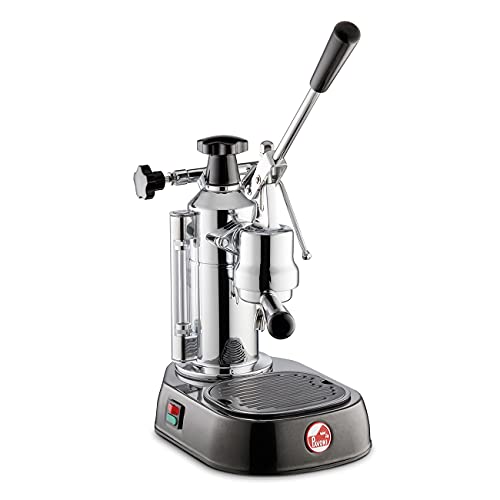
The Ideale was La Pavoni’s first espresso machine and directly derived from Bezzera’s Gigante design6. Early machines of this type were vertical, built to generate roughly 1.5 bar of pressure, and required about a minute to pull a single cup7. Serial production of the Ideale began in 1905, the same year Pavoni founded his workshop7.
The Europiccola: naming and design lineage
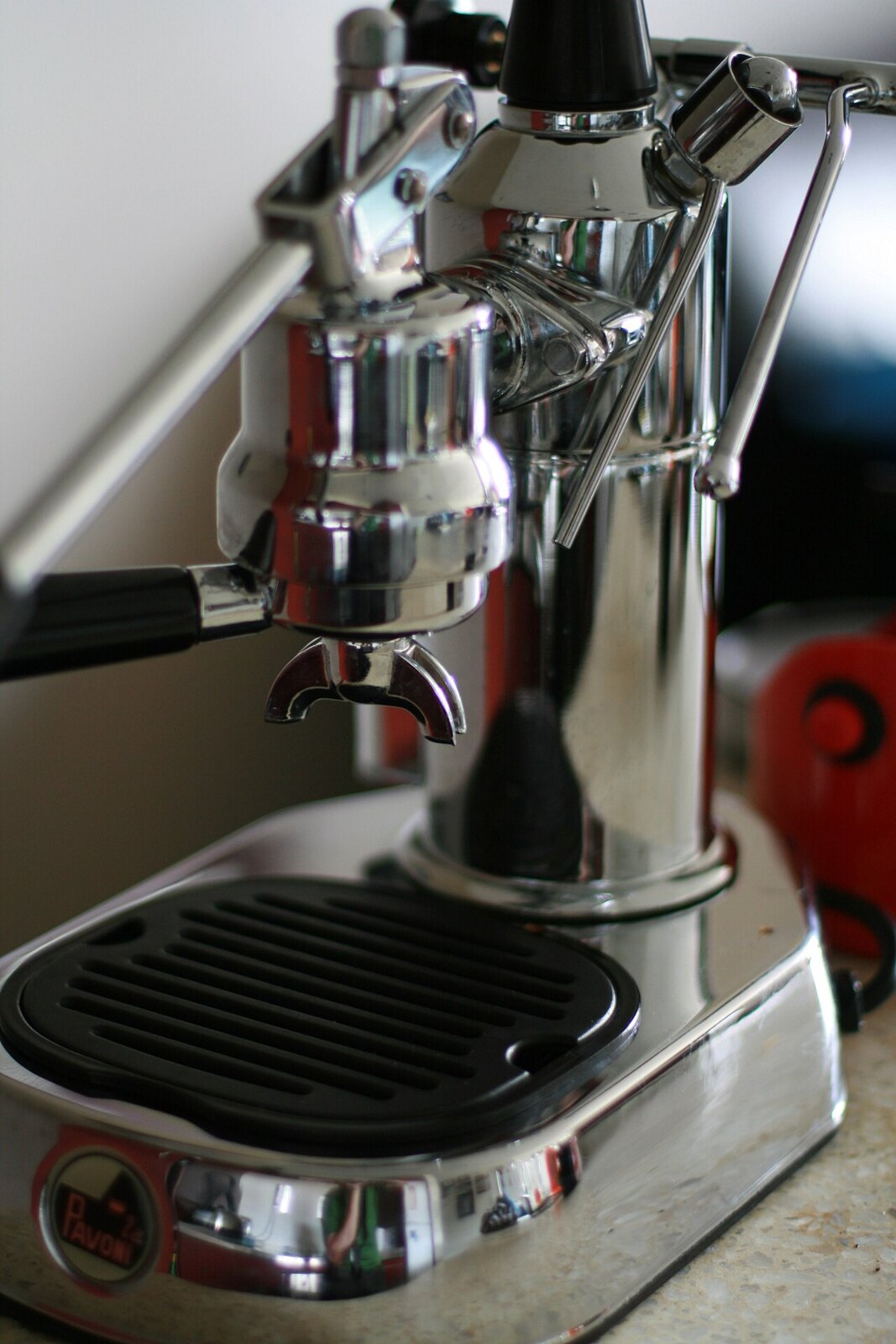
The name “Europiccola” directly references its diminutive size: piccola means “small” in Italian, and the machine was described as a miniature bar machine3. The machine debuted at the 1961 Strasbourg fair, marking its market entry that same year3.
Design attribution for the Europiccola is nuanced. Francesco Ceccarelli notes that Piero Diamanti secured an ornamental design patent for a small lever machine called the D.P. Caferina on 23 April 1959, a patent that lasted two years5. When the design patent expired, La Pavoni adopted the concept and began producing the Europiccola within months5. Thus, while La Pavoni marketed the machine under its own brand, the underlying design lineage traces back to Diamanti’s patented concept.


Evolution of the Europiccola
The original 1961 Europiccola featured a 0.8-litre boiler and lacked a sight glass4. A sight glass was introduced in the 1962 restyle, followed by a perforated aluminium-grid drip tray in 19644. Further aesthetic updates arrived in 1978 with chrome and brass-copper finishes4.
Wikipedia records that the original Europiccola had a 49 mm brewing group and a 50 mm piston6. Later, plastic and Teflon components entered the line in 1997, and the 2001 Millennium models expanded to a 51 mm group and a 60 mm piston6. These incremental technical changes illustrate how La Pavoni balanced the machine’s classic lever heritage with evolving material technologies.
The Professional lever machine and museum presence
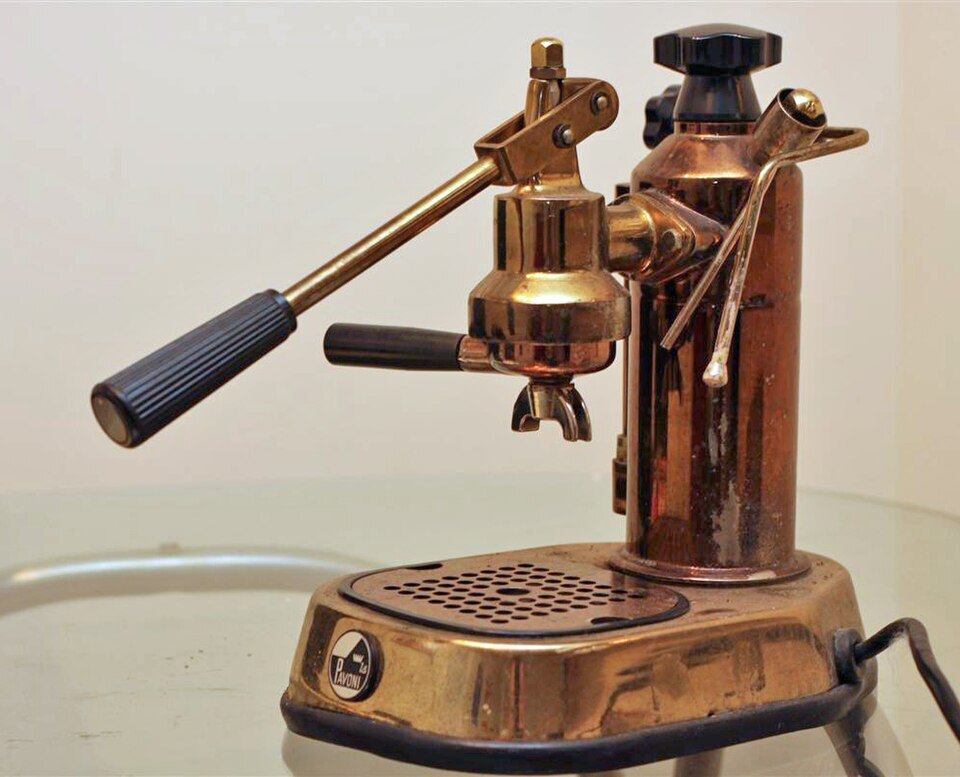
According to the centenary monograph, La Pavoni introduced the Professional lever machine in 1974, retaining the familiar lever shape, making twice the coffee, and adding a pressure gauge [Monograph - Professional intro]. Ceccarelli’s chronology places the Professional’s debut in 1977, while the monograph records its introduction in 1974, indicating a slight discrepancy between sources.
La Pavoni states that a 1974 Professional is on display at the Museum of Modern Art in New York, and Wikipedia notes that the machine was included in MoMA’s 2005 Architecture and Design inaugural installation alongside Schlumbohm’s Chemex.
Cultural footprint and design commentary
Beyond museums, La Pavoni lever machines have appeared in several films, reinforcing their cultural resonance. Wikipedia lists screen appearances for both the Europiccola and Professional in Live and Let Die (1973), Ransom (1996), The Talented Mr. Ripley (1999) - a film set in the 1950s - and About a Boy (2002)6.
Design writer Nina Bornsen (1994) described La Pavoni’s appeal as technological and functional, with a nostalgic charm like a small steam engine, and said it became a status symbol. La Pavoni’s own description of the hand-built Stradivari model, with its arch-shaped levers inspired by a violin, further illustrates the brand’s commitment to marrying musical proportion with espresso mechanics2.
Answering the key questions
Who founded La Pavoni and when?
Desiderio Pavoni opened the company in a small Milan workshop in 19051.
What was the Ideale?
The Ideale was La Pavoni’s first espresso machine, launched in 1905 and based on Luigi Bezzera’s earlier Gigante design. It was a vertical-boiler machine that generated about 1.5 bar of pressure and required roughly a minute per cup7.
Where does the name Europiccola come from?
The name “Europiccola” suits it because piccola means small, describing a miniature bar machine3.
Who designed the Europiccola?
The design traces to Piero Diamanti’s 1959 ornamental design patent for the D.P. Caferina. After the two-year patent expired, La Pavoni adopted the concept and released the Europiccola in 19615.
When did the Professional arrive?
The centenary monograph records the Professional’s introduction in 1974, while Ceccarelli’s chronology lists 1977; the monograph’s date is the primary source for the company’s official timeline3.
Is a La Pavoni really in MoMA?
La Pavoni states that a 1974 Professional is on display at MoMA, and Wikipedia notes its inclusion in the museum’s 2005 Architecture and Design inaugural installation26.
Closing thoughts
La Pavoni’s lever machines illustrate how a single patent transfer in the early 1900s sparked a century-long design journey. From the Ideale’s vertical boiler to the compact Europiccola, born of a short-lived ornamental patent, and the larger Professional that earned museum recognition, each iteration reflects a balance of engineering pragmatism and aesthetic refinement. The machines’ enduring presence in film and design discourse confirms that La Pavoni’s legacy is as much about visual identity as it is about espresso extraction. As the brand entered the Smeg Group in 20196, the lever tradition continues under new corporate stewardship, yet the core design language that began on Via Parini remains unmistakable.


